A pronoun is a word that takes the place of a noun or noun phrase so you do not have to repeat it. Words such as she, it, they, this, who, and everyone are pronouns. The noun a pronoun replaces is called its antecedent.
Pronouns keep writing short and smooth, but they also cause some of the most common errors in American English, from me versus I to references that leave readers guessing. This GrammarVista.com USA guide explains the main types of pronouns, the rules for case and agreement, and how to fix unclear pronouns in your own drafts.
Key Takeaways
- A pronoun replaces a noun, and the noun it replaces is its antecedent.
- The main types are personal, possessive, reflexive, demonstrative, interrogative, relative, indefinite, and reciprocal pronouns.
- Use subject forms (I, she, they) for doers and object forms (me, her, them) after verbs and prepositions.
- A pronoun should agree with its antecedent in number, and singular they is accepted by major U.S. style guides.
- If a reader could match a pronoun to two different nouns, repeat the noun instead.
How Pronouns Work in a Sentence
Compare these two versions of the same idea: Maria finished Maria’s report before Maria left the office. and Maria finished her report before she left the office. The second sentence is easier to read because her and she point back to Maria.
The antecedent usually comes first, the pronoun must match it in number, and the reader must be able to tell which noun the pronoun means.
The Main Types of Pronouns
Pronouns are grouped by the job they do, and writing labs such as the Excelsior OWL pronoun guide use similar categories.
Personal Pronouns
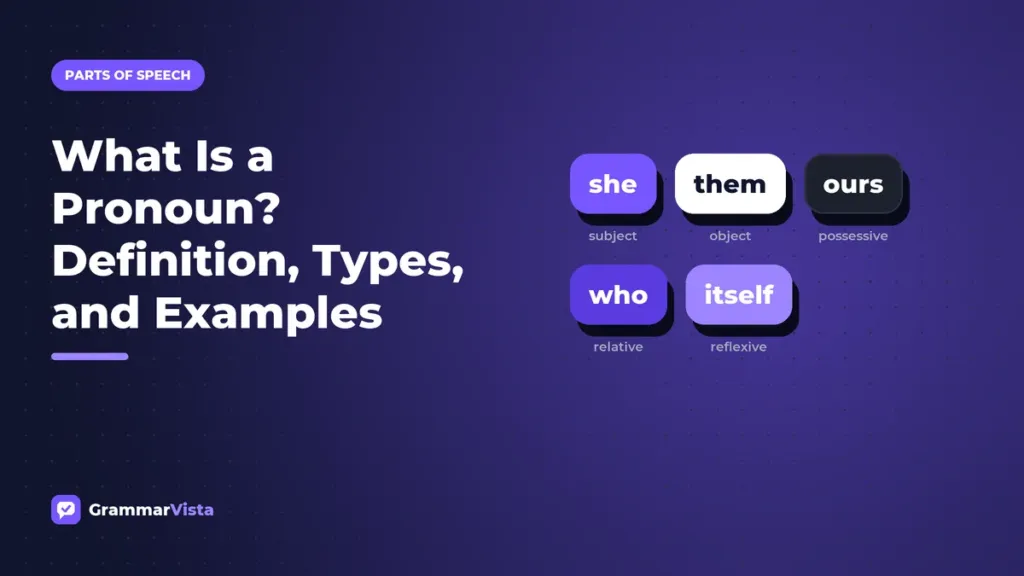
Personal pronouns refer to specific people or things: I, you, he, she, it, we, and they. Most change form for subject and object roles, as in She called him and He called her.
Possessive Pronouns
Possessive pronouns show ownership. Some come before a noun (my, your, his, her, its, our, their), and some stand alone (mine, yours, hers, ours, theirs). None of them uses an apostrophe, which is why the guide to its vs. it’s is worth bookmarking.
Reflexive and Intensive Pronouns
Words ending in -self or -selves are reflexive when the subject acts on itself (I reminded myself) and intensive when they add emphasis (The mayor herself answered the phone). Avoid using them as a polite substitute for me: write Contact Sam or me, not Contact Sam or myself.
Demonstrative Pronouns
This, that, these, and those point to something. Use this and these for things that are near, and that and those for things farther away.
Interrogative and Relative Pronouns
Interrogative pronouns ask questions: who, whom, whose, which, and what. Relative pronouns, including who, whom, whose, which, and that, introduce clauses that describe a noun, as in the editor who hired me. For the hardest pair, see our breakdown of who vs. whom.
Indefinite and Reciprocal Pronouns
Indefinite pronouns refer to people or things in general: everyone, someone, nobody, each, few, many, and several. Reciprocal pronouns, each other and one another, describe an action two or more people share.
| Type | Common Pronouns | Example Sentence |
|---|---|---|
| Personal | I, you, he, she, it, we, they | They moved the meeting to Friday. |
| Possessive | my, mine, your, yours, its, their, theirs | The blue umbrella is mine. |
| Reflexive | myself, yourself, themselves | The twins taught themselves to code. |
| Demonstrative | this, that, these, those | Those are the final drafts. |
| Interrogative | who, whom, whose, which, what | Which of the offers did you accept? |
| Relative | who, whom, whose, which, that | The bus that leaves at noon is full. |
| Indefinite | everyone, somebody, each, many | Everyone in the class passed the quiz. |
| Reciprocal | each other, one another | The neighbors helped one another. |
Pronoun Case: Subject, Object, or Possessive
Use the subject case when the pronoun performs the action, the object case after a verb or preposition, and the possessive case to show ownership.
- Drop the other person: In Jordan and me presented the plan, remove “Jordan and.” Since me presented sounds wrong, the correct version is Jordan and I presented the plan.
- Use object forms after prepositions: Write between you and me and for her and me, never between you and I.
- Finish the comparison: In She types faster than I, the hidden verb is do, so the subject form fits in formal writing.
Quick rule: If the pronoun does the action, use I, he, she, we, or they. If something is done to it or it follows a preposition, use me, him, her, us, or them.
Pronoun-Antecedent Agreement and Singular They
A pronoun should match its antecedent in number. A singular noun takes a singular pronoun, and a plural noun takes a plural one: The students submitted their essays; The company updated its policy.
In American English, collective nouns such as team, committee, and company usually count as singular, so its is the standard choice. Agreement also affects verbs, a topic covered in the Grammar Rules section of GrammarVista.com USA.
Singular they is now standard in many contexts. Merriam-Webster recognizes it, and APA Style recommends it when a person’s gender is unknown or when they is the pronoun a person uses: Each applicant should bring their ID. Note that singular they still takes a plural verb, so write they are, not they is.
How to Fix Vague Pronoun References
In When Priya met Dana, she was nervous, the word she could mean either person. Use these steps to catch the problem during revision:
- Circle each pronoun in a paragraph.
- Draw a line to the noun it replaces.
- If two nouns could fit, repeat the right noun or restructure: Priya was nervous when she met Dana.
- Replace a vague this or it with a noun phrase, such as this delay or the new schedule.
Practice: Choose the Correct Pronoun
Pick the correct word in each sentence.
- The manager asked Leah and (I / me) to review the budget.
- Every runner must pick up (his or her / their) bib by 7 a.m.
- (Who / Whom) left the lights on?
- The committee announced (its / it’s) decision on Monday.
- Please send the files to Chris or (me / myself).
Answer key:
- me, because it is the object of asked.
- Both are correct; their is more common in current American usage.
- Who, because it is the subject of left.
- its, the possessive form without an apostrophe.
- me, because myself needs an antecedent in the same clause.
The Bottom Line
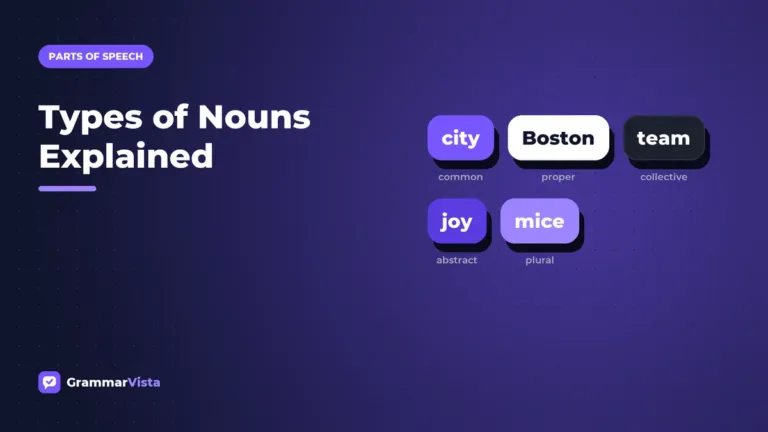
A pronoun stands in for a noun, and it works only when its form, number, and antecedent are clear. Use the drop-the-other-person test for case, and repeat a noun whenever a pronoun could point two ways. To keep building the basics, read our guide to the types of nouns or browse the Parts of Speech category on GrammarVista.com USA.
Frequently Asked Questions
Is “it” a pronoun?
Yes, it is a personal pronoun. It usually replaces a singular thing, animal, or idea, as in The printer jammed, so I fixed it. It can also act as a placeholder subject with no antecedent, as in It is raining or It seems late, which grammarians call a dummy subject.
What is the difference between a noun and a pronoun?
A noun names a specific person, place, thing, or idea, while a pronoun stands in for that noun. Carlos, Denver, and laptop are nouns; he, it, and this are pronouns. Writers use the noun first for clarity, then switch to a pronoun to avoid repeating the same word.
Can “they” refer to one person?
Yes, singular they can refer to one person whose gender is unknown or who uses they as a pronoun. APA Style recommends this use, and Merriam-Webster recognizes it. The verb stays plural, as in They are joining us later, even when only one person is meant.
When is “myself” correct?
Myself is correct when the subject of the same clause is I, as in I taught myself Spanish, or when you add emphasis, as in I wrote it myself. It is incorrect as a stand-in for me or I, so avoid sentences like Email John and myself.