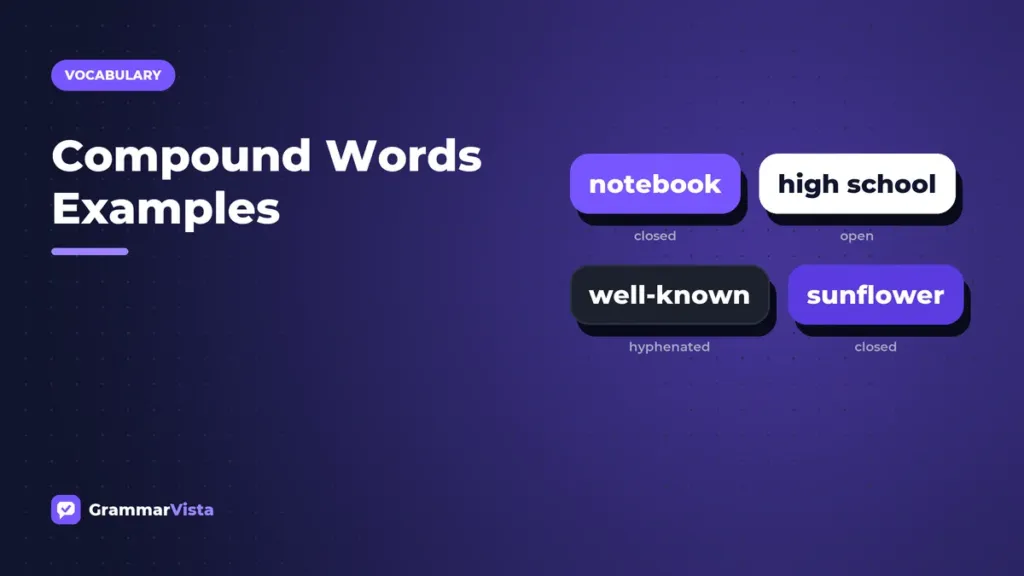
A compound word is a single term built from two or more words that work together as one unit of meaning, such as notebook, high school, or mother-in-law. English writes compounds in three ways: closed (one word), open (separate words), or hyphenated (joined by hyphens).
This guide from GrammarVista.com USA gives you clear compound words examples for each type, explains when a hyphen belongs before a noun, and shows how to form the plural of tricky compounds.
Key Takeaways
- Compound words come in three forms: closed (firefighter), open (ice cream), and hyphenated (self-esteem).
- Permanent compounds are listed in the dictionary; temporary compounds are created for a single sentence.
- Hyphenate most compound modifiers before a noun (a well-known author) but usually not after it (the author is well known).
- Never hyphenate an adverb ending in -ly with the word it modifies (a highly rated film).
- Plurals usually go on the main noun: mothers-in-law, attorneys general, passersby.
The Three Types of Compound Words
Every compound falls into one of three spelling patterns. The pattern is set by usage, not logic, so a dictionary such as Merriam-Webster is the final word for American writers.
Closed Compounds
Closed compounds join the words with no space. Many began as open or hyphenated forms and closed up over time as writers used them more often.
- bookstore, keyboard, sunflower, toothbrush
- weekend, firefighter, headline, email
Open Compounds
Open compounds keep a space between the words, yet readers still treat them as one idea. A post office is a single place, not just any office that happens to be posted.
- high school, ice cream, living room, real estate
- peanut butter, full moon, vice president, bus stop
Hyphenated Compounds
Hyphenated compounds link their parts with hyphens. Phrases with internal prepositions and many words built with self- follow this pattern.
- mother-in-law, merry-go-round, jack-of-all-trades
- self-esteem, well-being, x-ray, great-grandmother
Compound Words Examples at a Glance
The table below collects common compounds and shows how a word’s form can shift with its job in the sentence.
| Compound | Type | Example Sentence |
|---|---|---|
| notebook | Closed noun | Maya filled her notebook with lecture notes. |
| living room | Open noun | We moved the piano into the living room. |
| sister-in-law | Hyphenated noun | My sister-in-law teaches seventh-grade science. |
| setup / set up | Noun vs. verb | The setup took an hour because we had to set up six tables. |
| login / log in | Noun vs. verb | Log in with the login the office emailed you. |
| everyday / every day | Adjective vs. phrase | Walking is an everyday habit; I walk every day. |
Quick rule: Many phrasal verbs are open (back up, check in), while the matching noun is closed or hyphenated (backup, check-in).
Permanent vs. Temporary Compounds
The Chicago Manual of Style separates compounds into two groups, and the difference tells you where to look for the right spelling.
- Permanent compounds are established terms with a dictionary entry, such as firefighter, half-life, or sweet potato. Spell them exactly as the dictionary does.
- Temporary compounds are combinations a writer creates for the moment, such as a three-hour drive or a cat-loving neighbor. You will not find them in a dictionary, so you apply hyphenation rules instead.
If a dictionary lists more than one form, American publishers generally choose the first one shown.
Hyphenating Compound Modifiers Before a Noun
When two or more words act together as one adjective before a noun, a hyphen helps readers group them correctly. As the Naval Postgraduate School’s guide to dashes and hyphens explains, hyphenated nouns and verbs usually have standard dictionary forms, while compound adjectives are often hyphenated because of their position in the sentence.
- Before the noun, hyphenate: a long-term plan, a part-time job, a well-written report.
- After the noun, usually leave it open: The plan is long term. The report is well written.
- Skip the hyphen with -ly adverbs: a newly painted fence, a carefully planned trip.
- Use suspended hyphens for a shared base: first- and second-year students.
- Keep permanent hyphens everywhere: words such as self-aware stay hyphenated even after the noun.
The hyphen can change meaning. A small-business owner runs a small business, while a small business owner could be a short person who owns any business.
How to Make Compound Words Plural
The plural ending goes on the word that names the person or thing. For most closed compounds, that simply means adding -s or -es to the end.
| Singular | Plural | Why |
|---|---|---|
| mother-in-law | mothers-in-law | Mother is the main noun. |
| runner-up | runners-up | The runners are counted, not the up. |
| attorney general | attorneys general | General describes the attorneys. |
| passerby | passersby | The plural stays on passer. |
| toothbrush | toothbrushes | Closed compounds pluralize at the end. |
| high school | high schools | School is the main noun. |
Possessives work differently: add ‘s to the end of the whole compound, as in my sister-in-law’s car. For plural possessives, many writers rephrase, writing the cars of my sisters-in-law. Learn more about naming words in our guide to the types of nouns.
Practice: Choose the Correct Form
Test yourself with this short GrammarVista.com USA quiz. Pick the right spelling for each sentence.
- Please (back up / backup) your files before Friday.
- She wrote a (well researched / well-researched) article.
- Both of my (brother-in-laws / brothers-in-law) came to dinner.
- We need a (three-day / three day) extension.
- That was a (beautifully-designed / beautifully designed) logo.
Answer key: 1. back up (verb); 2. well-researched (modifier before a noun); 3. brothers-in-law; 4. three-day; 5. beautifully designed (no hyphen after an -ly adverb).
Compounds often contain word parts, too. Our guide to prefixes and suffixes explains when words such as nonprofit and re-cover take a hyphen, and the Punctuation section covers hyphens, dashes, and more.
The Bottom Line
Check the dictionary for permanent compounds, hyphenate most compound modifiers before a noun, and put plural endings on the main word. For more word-building help, browse the Vocabulary guides on GrammarVista.com USA.
Frequently Asked Questions
What are three examples of compound words?
Three clear examples are notebook, ice cream, and mother-in-law. Each shows a different type: notebook is closed, ice cream is open, and mother-in-law is hyphenated. In every case, the parts combine into one meaning that the separate words do not fully express on their own.
How do I know if a compound word is one word or two?
Look it up in a current dictionary, such as Merriam-Webster, because spelling depends on established usage rather than a fixed rule. If the compound is not listed, treat it as a temporary compound: leave it open as a noun and hyphenate it when it works as a modifier before another noun.
Is “email” written as one word in American English?
Yes, email is the standard closed spelling in American English. Merriam-Webster lists it as the main form, and the AP Stylebook dropped the hyphen in 2011. The older form e-mail still appears in some publications, but most American writers and editors now use the closed spelling.
Why is it “mothers-in-law” and not “mother-in-laws”?
The plural belongs on the main noun, and in mother-in-law the main noun is mother. The phrase in-law only describes which mothers you mean, so it stays the same. The same logic gives brothers-in-law, runners-up, and attorneys general in standard American usage.