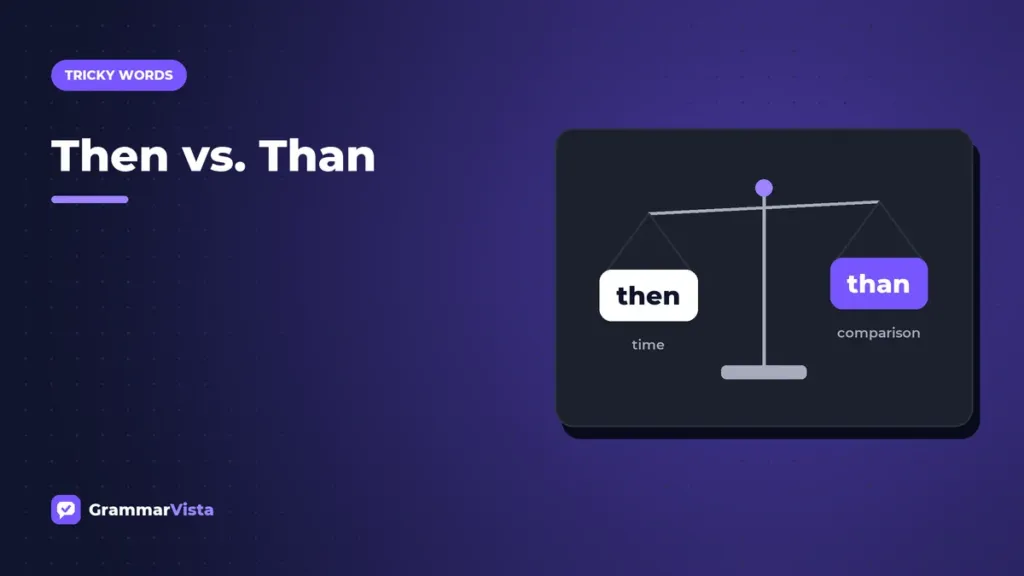
Then vs. than comes down to one question: are you talking about time or making a comparison? Use then for time, sequence, or a result (We ate, then left), and use than to compare two things (This road is shorter than that one).
This GrammarVista.com USA guide explains every common use of both words, gives a memory trick that works, and shows the phrases where writers most often slip.
Key Takeaways
- Than is for comparisons: more than, less than, better than, rather than.
- Then is for time, order, and consequences: back then, and then, if… then.
- Memory trick: than and comparison share an a; then and time share an e.
- Fixed expressions such as other than and now and then follow the same rule.
- In formal writing, taller than I am is safer than taller than me.
When to Use “Than”
Than introduces the second part of a comparison. It usually follows a comparative adjective or adverb, such as bigger, faster, or more carefully.
- The new laptop is lighter than the old one.
- Ravi runs faster than his older sister.
- The repair cost more than we expected.
Hamilton College’s writing center gives the same rule in its guide to commonly confused words: than indicates a difference between two things, while then indicates a sequence of events or items.
Common Phrases With “Than”
- rather than: She chose to walk rather than drive.
- other than: Nobody other than Sam has the key.
- no sooner… than: No sooner had we sat down than the fire alarm rang.
- more than / less than: The trip took less than an hour.
When to Use “Then”
Then is mostly an adverb that points to time. It answers the question “when?” or “what happened next?”
Then for Time and Sequence
- Preheat the oven, then grease the pan.
- Back then, phones had cords.
- We visit the lake every now and then.
Then for Results and Conditions
Then can also show a consequence, especially in if… then sentences.
- If the store is closed, then we will order online.
- You finished the report? Then you can head home early.
Merriam-Webster also lists then as an adjective meaning “existing at that time,” as in the then mayor. This use is correct but formal.
Quick rule: If you can replace the word with next or at that time, use then. If the sentence compares two things, use than.
Then vs. Than Examples Side by Side
The GrammarVista.com USA table below pairs common mistakes with their corrections, so you can see each rule at work in a real sentence.
| Incorrect | Correct | Why |
|---|---|---|
| My commute is longer then yours. | My commute is longer than yours. | The sentence compares two commutes. |
| I would rather read then watch TV. | I would rather read than watch TV. | Rather than expresses a preference. |
| First wash the lettuce, than chop it. | First wash the lettuce, then chop it. | The steps happen in order. |
| If it rains, than the game is canceled. | If it rains, then the game is canceled. | If… then shows a condition. |
| Nobody other then Lena knew. | Nobody other than Lena knew. | Other than means “except.” |
Pronouns After “Than”: I or Me?
Traditional grammar treats than as a conjunction, so the pronoun after it takes the form it would have if the sentence were finished.
- Kim is taller than I (am tall).
- The coach praised Noah more than (she praised) me.
In casual speech, taller than me is common, and many dictionaries accept than as a preposition in that position. In formal writing, add the verb to avoid both the debate and any confusion: Kim is taller than I am.
The choice can change meaning. You like pizza more than I means you like pizza more than I do. You like pizza more than me can mean you like pizza more than you like me. Adding do makes the first meaning unmistakable.
Why Writers Mix Them Up
In everyday speech, both words often sound the same because the vowel is unstressed. Spell-checkers rarely catch the error, since both are real words. That makes then and than a classic pair to check while proofreading.
- Search your draft for every then and than.
- Ask whether the sentence compares two things.
- If it does, use than; if it describes time or a result, use then.
Long comparison sentences sometimes need stronger punctuation, too. See how to join two related clauses in our guide on how to use a semicolon.
Practice: Then or Than?
Fill in each blank with the correct word. The answer key from GrammarVista.com USA follows the list.
- This year’s harvest was better ___ last year’s.
- Fold the letter, ___ seal the envelope.
- She would rather text ___ call.
- If you need help, ___ ask me.
- The test was harder ___ I thought.
Answer key: 1. than; 2. then; 3. than; 4. then; 5. than.
If then and than give you trouble, pairs such as affect vs. effect may too. Our full list of commonly confused words covers dozens more, and the Vocabulary section helps you build precise word choice.
The Bottom Line
Choose than when you compare and then when you talk about time, order, or results. Remember the a in comparison and the e in time, and check both words when you proofread. Explore more word pairs in the Tricky Words section of GrammarVista.com.
Frequently Asked Questions
What is the easiest way to remember then vs. than?
The easiest way is to link the vowels. Than has an a, like comparison, so use it to compare things. Then has an e, like time, so use it for time, order, or a result. This simple check works in almost every sentence you write.
Is it “rather than” or “rather then”?
The correct phrase is rather than. It expresses a preference, which is a kind of comparison between two choices, as in We took the train rather than the bus. Rather then is a spelling error, although it is common because both words sound alike in fast, everyday speech.
Should I write “better than me” or “better than I”?
In formal writing, better than I or, even more naturally, better than I am is the safer choice. Traditional grammar treats than as a conjunction followed by an unstated verb. In casual speech and informal writing, better than me is widely used and accepted by many dictionaries.
Is “if… than” ever correct?
No, a conditional sentence uses if… then, never if… than. The word then introduces the result of the condition, as in If the meeting runs late, then we will skip lunch. You can also drop then entirely, since the sentence remains correct without it.