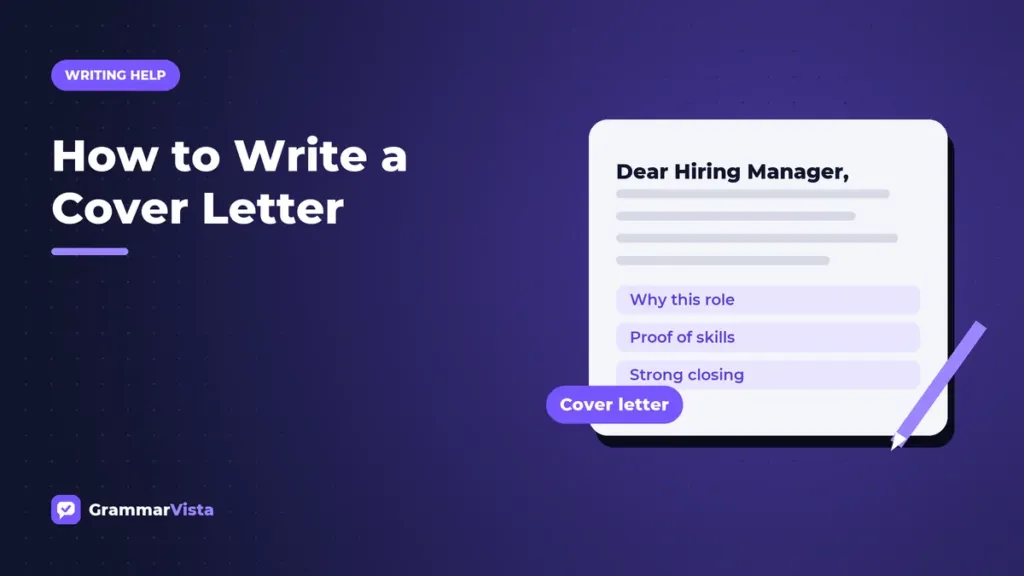
To write a cover letter, address the hiring manager by name, open with the job you want and your strongest qualification, prove two or three skills with specific examples, and close by asking for an interview. In the United States, a cover letter fits on one page, runs three or four short paragraphs, and is tailored to a single job posting.
This step-by-step guide from GrammarVista.com USA gives you a method, a fill-in template, and side-by-side examples you can adapt today.
Key Takeaways
- Keep a U.S. cover letter to one page: a greeting, three or four short paragraphs, and a sign-off.
- Tailor every letter to one posting by matching its top requirements with your own evidence.
- Lead with the role and your best qualification, not with “My name is.”
- Replace adjectives such as “hardworking” with concrete results you can verify.
- Proofread names, titles, and company details twice before you send the letter.
What a Cover Letter Does
A resume lists what you have done. A cover letter connects that history to one employer’s needs and shows how well you write.
It also gives you room to explain what a resume cannot, such as a career change, a move to a new city, or a gap between jobs. If a sentence simply repeats a resume bullet, cut it or replace it with the story behind that bullet.
U.S. Cover Letter Format Basics
Most U.S. employers expect the same basic layout. Follow these conventions unless the posting asks for something different.
- Length: one page, with three or four paragraphs of body text.
- Font and margins: a readable font at 10 to 12 points with one-inch margins.
- Header: your name, phone number, email address, and city and state; a portfolio or LinkedIn link is optional.
- Greeting: “Dear Ms. Rivera:” or “Dear Hiring Manager:” in a formal letter; a comma after the greeting is fine in an email.
- Personal details: no photo, birth date, or marital status. U.S. employers generally do not expect them.
- File type: PDF unless the employer requests a Word document, with a clear file name such as “Jordan-Lee-Cover-Letter.pdf.”
How to Write a Cover Letter in 7 Steps
Step 1: Study the Job Posting
Highlight the three or four requirements that appear first or most often. These are your targets, and each body paragraph should answer at least one of them.
Step 2: Find the Right Name
Check the posting, the company website, and professional networking profiles for the hiring manager or recruiter. If you cannot find a name, the UC Berkeley Career Engagement cover letter guide recommends keeping it simple with “Dear Hiring Manager.”
Step 3: Open With the Role and Your Hook
Name the exact job title and give one reason you are a strong match. If a current employee referred you, mention that person in the first sentence.
Step 4: Prove Your Fit With Evidence
Use one or two body paragraphs. Pick a requirement, then describe a specific time you met it: the situation, your action, and the result.
Use numbers you can verify, such as the size of a team you led, a deadline you met, or a budget you managed.
Step 5: Show You Know the Employer
Add one or two sentences about the company’s work, product, or mission and why it matters to you. Specific details always beat general praise.
Step 6: Close With a Clear Next Step
Thank the reader, restate your interest, and ask for a conversation. End with “Sincerely,” followed by your typed full name.
Step 7: Edit and Proofread
Cut filler, check your verb tenses, and read the letter aloud. Our guide on how to proofread your writing walks you through a complete final check.
Cover Letter Template
Copy this outline into a document and replace each bracketed note with your own details. The structure in this GrammarVista.com USA template follows standard American business-letter format.
[Your Name] | [City, State] | [Phone] | [Email]
[Month Day, Year]
[Hiring Manager’s Name]
[Title]
[Company]
[City, State]Dear [Mr./Ms./Mx. Last Name or Hiring Manager]:
I am applying for the [Job Title] position at [Company]. With [number] years of experience in [field or skill], I [one-sentence proof of your strongest qualification].
In my role at [Employer], I [action you took] to [solve a problem or meet a goal], which [specific result]. This experience prepared me to [requirement from the posting].
I am drawn to [Company] because [specific detail about its work, product, or values]. I would bring [skill or quality] to [team or project named in the posting].
Thank you for your consideration. I would welcome the chance to discuss how I can help [Company] [reach a goal]. You can reach me at [phone] or [email].
Sincerely,
[Your Name]
If you paste the letter into the body of an email instead of attaching it, drop the address block and put the job title in the subject line. Our guide to writing a professional email covers subject lines, greetings, and sign-offs.
Weak vs. Strong Cover Letter Lines
| Weak | Strong | Why It Works |
|---|---|---|
| “My name is Jordan Lee, and I am applying for your job.” | “I am applying for the Marketing Coordinator role, and my three years running social media campaigns match your top requirement.” | Names the role and a qualification in one sentence. |
| “I am a hard worker and a team player.” | “I coordinated a five-person team that launched our spring newsletter two weeks early.” | Replaces adjectives with a result the reader can picture. |
| “I think I would be a good fit.” | “My experience scheduling vendors matches the logistics duties in your posting.” | Sounds confident and ties directly to the posting. |
| “To Whom It May Concern,” | “Dear Ms. Patel:” or “Dear Hiring Manager:” | Direct, current, and properly punctuated. |
| “Hoping to hear from you soon!!” | “I would welcome the chance to discuss the role. Thank you for your time.” | Polite, polished, and free of extra punctuation. |
Grammar and Style Checks Before You Send
Small errors stand out in a short document. Run through this checklist, and review the basics in our Grammar Rules section if anything feels uncertain.
- Use active voice for achievements: “I trained new hires,” not “New hires were trained by me.”
- Keep tenses consistent: present tense for your current job and past tense for earlier jobs.
- Vary sentence openings so that only a few sentences start with “I.”
- Spell the company name and the manager’s name exactly as they appear on the company website.
- Match the job title word for word, including its capitalization.
- Cut empty intensifiers such as “very,” “really,” and “extremely.”
The Bottom Line
A strong cover letter is short, specific, and written for one job. Study the posting, prove two or three qualifications with real examples, and close with a clear request for an interview.
Browse more step-by-step guides in our Writing Help section, or return to GrammarVista.com USA for grammar and usage help.
Frequently Asked Questions
How long should a cover letter be?
A cover letter should fit on one page, which usually means three or four short paragraphs. Hiring managers often skim, so a focused letter that proves two or three qualifications works better than a long one. If the employer sets a word limit or asks specific questions, follow those instructions exactly.
Do I need a cover letter if the application says it is optional?
Yes, in most cases you should send one. An optional cover letter is a chance to explain your interest, connect your experience to the posting, and show your writing skills. Keep it brief and tailored, because a generic letter adds little and may weaken an otherwise strong application.
Should I include a photo with a U.S. cover letter?
No, U.S. job applications normally leave out photos. Employers in the United States generally do not expect a photo, birth date, or marital status on application documents. Include your name, phone number, email address, and city and state instead, plus a portfolio link if your field commonly uses one.
Can I use the same cover letter for every job?
You can reuse a basic structure, but you should rewrite the content for each job. Change the job title, company name, and greeting, then swap in the examples that best match that posting’s top requirements. A letter that clearly fits one role is far more persuasive than a general one.