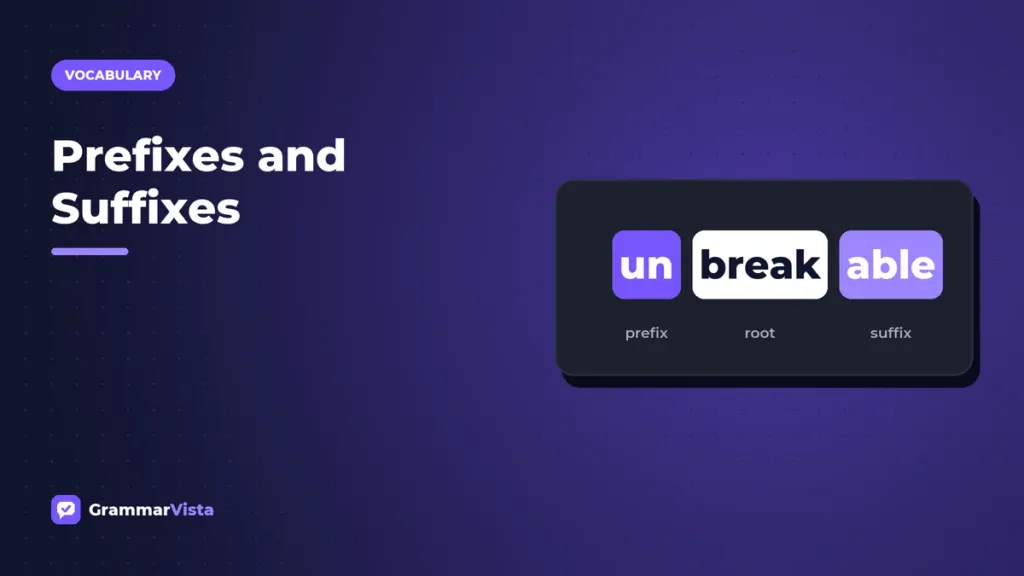
Prefixes and suffixes are word parts added to a base word to build a new word. A prefix goes at the beginning and usually changes the meaning (happy becomes unhappy), while a suffix goes at the end and often changes the part of speech (happy becomes happiness).
In this GrammarVista.com USA guide, you will learn the most useful prefixes and suffixes, the spelling rules that apply when you attach them, and the cases where American style calls for a hyphen.
Key Takeaways
- A prefix attaches to the front of a word and changes its meaning: un-, re-, pre-, mis-.
- A suffix attaches to the end and often changes the word class: -ness, -ment, -ful, -ly.
- Adding a prefix never changes the spelling of the base word, which is why misspell has two s’s.
- Suffixes follow three main spelling rules: drop the silent e, change y to i, and double the final consonant.
- American English closes most prefixes (nonprofit, coworker) but hyphenates before capitals, numbers, and confusing forms.
What Prefixes Do
A prefix adds a fixed meaning to the start of a word. Once you know that pre- means “before,” words such as preview, preheat, and prepay become easy to decode.
Many English prefixes come from Latin and Greek. The Southern Illinois University Carbondale Writing Center offers a helpful list of common word parts with the meaning of each prefix, root, and suffix.
Prefixes That Mean “Not” or “Opposite”
- un-: unclear, unlock, unfair
- dis-: disagree, dishonest, disconnect
- in-, im-, il-, ir-: inactive, impossible, illegal, irregular
- non-: nonfiction, nonstop, nonessential
Prefixes for Time, Place, and Degree
- re- (again): rewrite, reread, rebuild
- sub- (under): subway, subtitle, submarine
- inter- (between): international, interview, interstate
- over- (too much): overcook, overdue, overthink
What Suffixes Do
A suffix usually tells you what job a word does in a sentence, and the GrammarVista.com USA table below shows the most common ones. Change the ending, and a verb can become a noun or an adjective can become an adverb.
| Suffix | Creates | Example | Sample Sentence |
|---|---|---|---|
| -ness | Noun | kind → kindness | Her kindness surprised the new hires. |
| -ment | Noun | agree → agreement | The tenants signed the agreement on Monday. |
| -ful | Adjective | help → helpful | The librarian gave us a helpful tip. |
| -less | Adjective | care → careless | One careless typo changed the price. |
| -able / -ible | Adjective | read → readable | Short paragraphs keep a report readable. |
| -ize | Verb | modern → modernize | The city plans to modernize its parks. |
| -ly | Adverb | quick → quickly | He answered the email quickly. |
American English prefers -ize where British English often allows -ise, so Americans write organize and apologize.
Spelling Rules for Adding Prefixes
The prefix rule is simple: attach the prefix and keep every letter of the base word. That is why some words end up with double letters.
- mis + spell = misspell
- un + necessary = unnecessary
- dis + satisfied = dissatisfied
- il + logical = illogical
Quick rule: A prefix never removes a letter from the base word. If both the prefix and the word supply the same letter, keep both.
Spelling Rules for Adding Suffixes
Suffixes cause more spelling changes than prefixes do. These three rules cover most cases.
- Drop the silent e before a vowel suffix. Hope becomes hoping, and write becomes writing. Keep the e before a consonant suffix: hopeful, careless. Common exceptions include noticeable, argument, and truly.
- Change y to i after a consonant. Happy becomes happiness, and carry becomes carried. Keep the y before -ing (carrying) and after a vowel (enjoyment).
- Double the final consonant in short, stressed words. Run becomes running, and begin becomes beginning. In American English, words stressed on the first syllable usually do not double: traveled, canceled, labeled.
The -able and -ible endings have no perfect rule. As a tendency, -able often follows a complete word (washable, comfortable), while -ible often follows a root that cannot stand alone (visible, edible). When in doubt, check the dictionary.
When to Hyphenate a Prefix
American dictionaries and the Chicago Manual of Style close most prefixes, giving forms such as nonprofit, antibacterial, and coworker. Use a hyphen in these situations instead:
- Before a capitalized word: pre-Columbian, un-American, mid-July
- Before a number: pre-1990, post-2020
- With self-, ex-, and all-: self-taught, ex-partner, all-inclusive
- To prevent a misreading: re-cover (cover again) vs. recover (get better); re-sign (sign again) vs. resign (quit)
Style guides differ on doubled vowels. The AP Stylebook writes re-enter, while many dictionaries also accept reenter. Pick one style and use it consistently. Prefixes also appear inside many compound words, which have their own hyphen rules.
Practice: Build the Correct Word
Try this GrammarVista.com USA exercise. Add the prefix or suffix and spell the new word correctly.
- mis + step
- busy + ness
- refer + ed
- use + ful
- re + sign (meaning “sign again”)
Answer key: 1. misstep; 2. business; 3. referred (stress falls on the last syllable); 4. useful (keep the e before a consonant suffix); 5. re-sign (the hyphen separates it from resign).
Some word parts also create look-alike words that writers mix up, such as affect and effect. See our list of commonly confused words for more pairs, and explore how suffixes signal word class in the Parts of Speech guides.
The Bottom Line
Prefixes change meaning, and suffixes change word class. Keep the base spelling when you add a prefix, apply the three suffix rules, and hyphenate only when style or clarity requires it. Find more vocabulary lessons in the Vocabulary section of GrammarVista.com.
Frequently Asked Questions
What is the difference between prefixes and suffixes?
A prefix is added to the beginning of a word, and a suffix is added to the end. Prefixes such as un- and re- mainly change meaning, while suffixes such as -ness and -ly usually change the part of speech. Both attach to a base word or root to create a new word.
Can a word have both a prefix and a suffix?
Yes, many English words contain both. Unhelpful combines the prefix un-, the base help, and the suffix -ful. Rearrangement uses re-, arrange, and -ment. Breaking long words into these parts is a reliable way to work out their meaning and spelling.
Why does “misspell” have two s’s?
Misspell has two s’s because the prefix mis- ends in s and the base word spell begins with s. Adding a prefix never removes a letter from the base word, so both letters stay. The same rule explains unnecessary, dissatisfied, and illogical.
Do Americans write “nonprofit” or “non-profit”?
American English writes nonprofit as one closed word. Merriam-Webster, the AP Stylebook, and the Chicago Manual of Style all close most words that begin with non-. A hyphen appears only in special cases, such as before a capitalized word, as in non-English, or when the closed form would confuse readers.