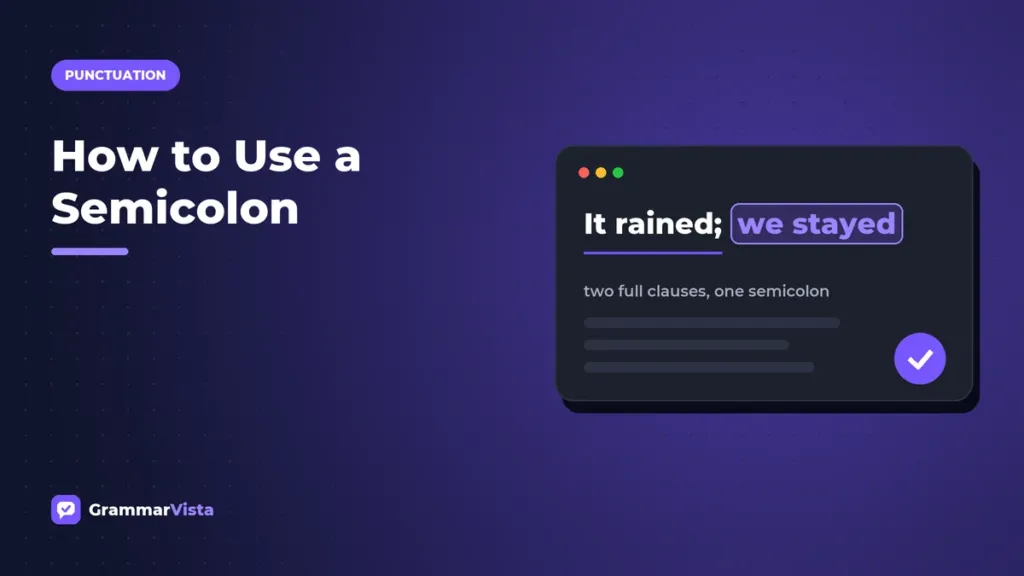
To use a semicolon correctly, place it between two independent clauses that are closely related, before a conjunctive adverb such as however that joins two clauses, or between items in a list that already contain commas. A semicolon is stronger than a comma but weaker than a period.
This GrammarVista.com USA guide goes beyond the basics: you will see how semicolons work with transitions, how they untangle complex lists, and which mistakes trip up even careful writers.
Key Takeaways
- Both sides of a semicolon joining clauses must be complete sentences.
- Before a conjunctive adverb that starts a new clause, use a semicolon before it and a comma after it: ; however,
- Use semicolons to separate list items that contain their own commas.
- Do not capitalize the word after a semicolon unless it is a proper noun or the pronoun I.
- In American punctuation, semicolons go outside closing quotation marks.
Rule 1: Join Two Independent Clauses
An independent clause has a subject and a verb and can stand alone as a sentence. When two of these clauses are closely connected, a semicolon can join them without a conjunction.
- The bakery opens at six; the line starts forming at five thirty.
- Jordan handled the budget; Priya wrote the grant proposal.
The semicolon signals that the ideas belong together. The Naval Postgraduate School’s guide to semicolons and colons notes that a semicolon indicates a close conceptual relation between discrete ideas. If the clauses are unrelated, use a period instead.
The Test: Could Each Side Be a Sentence?
Cover everything after the semicolon and read what remains. Then cover everything before it. If either part cannot stand alone, the semicolon is wrong.
Quick rule: If you can replace the semicolon with a period and get two correct sentences, the semicolon is probably correct.
Rule 2: Use a Semicolon Before Conjunctive Adverbs
Conjunctive adverbs and transitional phrases connect ideas, but they are not conjunctions. They cannot join two clauses with only a comma. Common examples include however, therefore, moreover, consequently, meanwhile, instead, in fact, and for example.
Put a semicolon before the transition and a comma after it.
- The flight was delayed; however, the crew kept everyone informed.
- Sales rose in March; in fact, they doubled.
When “However” Sits Mid-Clause
If however interrupts a single clause rather than starting a new one, set it off with commas only: The committee, however, rejected the plan. The semicolon belongs only where one complete clause ends and another begins.
Rule 3: Separate Complex List Items
Normally, commas separate the items in a series. When the items already contain commas, semicolons keep the groups clear.
The tour stops in Austin, Texas; Denver, Colorado; and Portland, Oregon.
The panel included Ana Ruiz, a nurse; Ben Cho, a teacher; and Lee Park, an engineer.
Notice that a semicolon also appears before and at the end of the list. This matches the Oxford comma style that most American book and academic publishers follow. Read more about that style choice in our guide to American punctuation rules.
Optional Use: Before a Conjunction in Long Sentences
A comma usually comes before a coordinating conjunction such as and or but that joins two clauses. If those clauses already contain several commas, a semicolon before the conjunction can make the main break easier to see.
We packed tents, stoves, and lanterns; but when we reached the campsite, rain, wind, and mud forced us home.
Use this option sparingly. Rewriting the sentence as two shorter sentences is often the better choice.
Semicolon Examples: Right vs. Wrong
| Incorrect | Correct | Why |
|---|---|---|
| I studied all week, however, the test was hard. | I studied all week; however, the test was hard. | A comma before however creates a comma splice. |
| Because the road was icy; we stayed home. | Because the road was icy, we stayed home. | The first part is a dependent clause. |
| You need three items; a pen, a notebook, and a calculator. | You need three items: a pen, a notebook, and a calculator. | A colon, not a semicolon, introduces a list. |
| The store closed early; And we went home. | The store closed early; we went home. | Do not capitalize after a semicolon, and drop the extra conjunction. |
| She called it “a bargain;” it cost twice as much. | She called it “a bargain”; it cost twice as much. | Semicolons go outside closing quotation marks. |
Common Semicolon Mistakes to Avoid
- Using a semicolon where a comma belongs. A semicolon cannot attach a phrase or dependent clause to a sentence.
- Confusing the semicolon with the colon. A colon introduces an explanation, quotation, or list; a semicolon links equal parts.
- Adding a space before it. Type the semicolon directly after the word, followed by one space.
- Overusing it. Several semicolons in one paragraph can make writing feel heavy. Mix them with periods and conjunctions.
- Ignoring agreement on each side. Each clause still needs a subject and verb that match, so review subject-verb agreement if your clauses are long.
Practice: Fix the Punctuation
Try this GrammarVista.com USA exercise. Decide whether each sentence needs a semicolon, a comma, or a colon. Answers follow the list.
- The printer jammed again therefore we sent the file to the library.
- Although the movie was long it held our attention.
- The finalists came from Reno, Nevada Boise, Idaho and Tulsa, Oklahoma.
- Bring one thing to class your signed permission slip.
- Maria prefers tea her brother prefers coffee.
Answer key: 1. again; therefore, 2. long, it (comma after a dependent clause); 3. Nevada; Boise, Idaho; and Tulsa; 4. class: your (colon); 5. tea; her.
Clear punctuation works best alongside clear word choice. Our guide to then vs. than fixes another common mix-up, and the full Grammar Rules section covers clauses, fragments, and run-ons.
The Bottom Line
Use a semicolon to join two related independent clauses, to come before a conjunctive adverb that starts a second clause, and to separate list items that contain commas. When neither side can stand alone, choose a comma or colon instead. For more mark-by-mark help, visit the Punctuation guides on GrammarVista.com USA.
Frequently Asked Questions
When should you use a semicolon instead of a comma?
Use a semicolon instead of a comma when you join two independent clauses without a coordinating conjunction, or when list items already contain commas. A comma alone between two complete sentences creates a comma splice. A semicolon fixes it while keeping the closely related ideas together in one sentence.
Do you put a comma after “however” following a semicolon?
Yes, a comma normally follows however when it comes after a semicolon and begins the second clause: The tickets sold out; however, a second show was added. The same pattern applies to therefore, moreover, consequently, and transitional phrases such as in fact and for example.
Should the word after a semicolon be capitalized?
No, the word after a semicolon stays lowercase unless it is a proper noun, an acronym, or the pronoun I. Because a semicolon joins parts of one sentence, the second clause does not start a new sentence. Write The museum closed; we ate lunch nearby, not ; We ate lunch nearby.
What is the difference between a semicolon and a colon?
A semicolon links two equal, independent parts of a sentence, while a colon introduces something that explains, lists, or expands on what came before. The words before a colon must form a complete sentence, but the words after it can be a single word, a list, or a full clause.