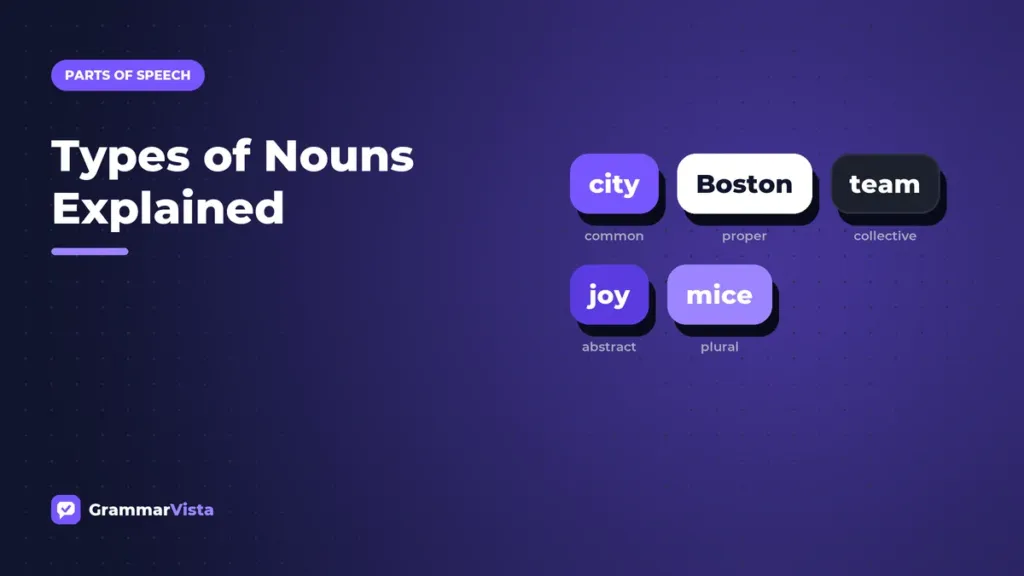
The main types of nouns are common and proper nouns, concrete and abstract nouns, count and noncount nouns, collective nouns, compound nouns, and possessive nouns. A noun names a person, place, thing, or idea, and most nouns belong to several of these types at once.
Knowing the types helps you capitalize correctly, choose between fewer and less, and match nouns with the right verbs. This GrammarVista.com USA guide defines each type, gives original examples, and ends with a short practice set.
Key Takeaways
- Common nouns name general things, while proper nouns name specific ones and are capitalized.
- Concrete nouns can be sensed; abstract nouns name ideas, qualities, and feelings.
- Count nouns have plural forms, but noncount nouns such as advice and equipment do not.
- In American English, collective nouns like team and staff usually take singular verbs.
- One noun can fit several types: Chicago is proper, concrete, and countable.
What Counts as a Noun
A noun is a word that names something. It can be a person (nurse), a place (Ohio), a thing (stapler), or an idea (justice). Overviews such as the Excelsior OWL guide to nouns use the same basic definition.
If you are unsure whether a word is a noun, try three quick tests:
- Can you put a, an, or the in front of it? (the decision)
- Can it act as the subject of a sentence? (The decision surprised everyone.)
- Can it be replaced by a pronoun such as it or they?
Common Nouns vs. Proper Nouns
A common noun names a general category: city, river, company, holiday. A proper noun names one specific member of that category and starts with a capital letter: Phoenix, the Mississippi River, Ford Motor Company, Thanksgiving.
Capitalization questions are the most common trouble spot. In American English, days and months are proper nouns (Monday, July), but seasons are not (spring, winter). Compass directions stay lowercase unless they name a region: drive south, but grew up in the South.
Concrete Nouns vs. Abstract Nouns
A concrete noun names something you can see, hear, touch, taste, or smell: coffee, thunder, sidewalk. An abstract noun names an idea, quality, state, or feeling: honesty, freedom, patience, confusion.
Abstract nouns are useful, but too many of them make writing vague. Compare There was a lack of communication with The team did not share the deadline. The second version replaces abstractions with concrete actors and actions.
Count Nouns vs. Noncount Nouns
Count nouns name things you can count, so they have singular and plural forms: one chair, three chairs. Noncount nouns, also called mass nouns, name things treated as a whole: information, advice, equipment, furniture, luggage, and homework.
The difference changes the words around the noun:
- Use many and fewer with count nouns: fewer emails, many questions.
- Use much and less with noncount nouns: less traffic, much research.
- Do not add -s to noncount nouns. Write some advice or two pieces of advice, not advices.
Some nouns can be either, depending on meaning. Experience is noncount in She has experience in sales but countable in We had two strange experiences on the trip.
Collective Nouns
A collective noun names a group as a single unit: team, committee, jury, staff, audience, and family. The Excelsior OWL page on collective nouns covers how these words behave with verbs.
In American English, collective nouns usually take a singular verb and pronoun: The jury has reached its verdict. When members act separately, many writers rephrase to avoid an awkward plural: The jury members disagree about the evidence. British English uses plural verbs with collective nouns more often, so the examples on GrammarVista.com USA follow the American pattern.
Compound Nouns
A compound noun combines two or more words into one noun. It can be closed (notebook), hyphenated (sister-in-law), or open (high school). A current dictionary is the best guide to which form a compound takes, and our guide to compound words explains the patterns in detail.
To make a compound noun plural, pluralize the main word: sisters-in-law, attorneys general, passersby. Closed compounds usually add -s at the end: toothbrushes, bookcases.
Possessive Nouns
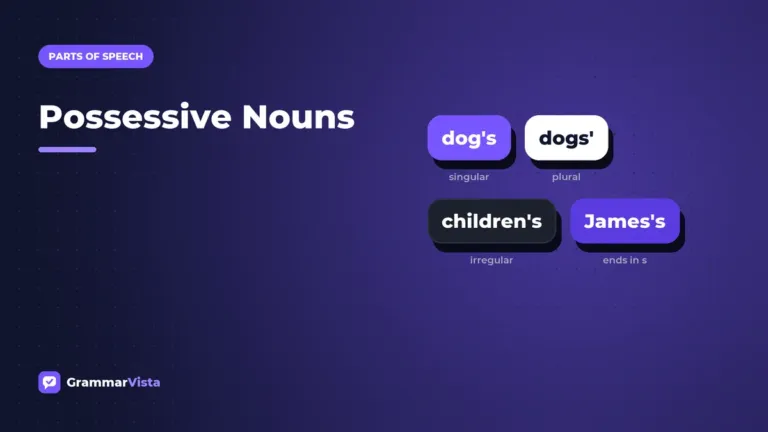
A possessive noun shows ownership or a close relationship, usually with an apostrophe: the doctor’s office, the players’ lockers. The apostrophe’s position depends on whether the noun is singular or plural, which our full guide to possessive nouns covers step by step.
Gerunds: Verbs Working as Nouns
A gerund is an -ing verb form that acts as a noun: Swimming is good exercise or She enjoys cooking. Gerunds can be subjects and objects, just like other nouns, and they often appear in titles and lists.
| Noun Type | What It Names | Example Sentence |
|---|---|---|
| Common | A general person, place, or thing | The library closes at nine. |
| Proper | A specific person, place, or thing | Lake Tahoe was calm this morning. |
| Concrete | Something you can sense | The bread smelled amazing. |
| Abstract | An idea, quality, or feeling | Her confidence grew each week. |
| Count | Things you can count | We packed four boxes. |
| Noncount | Things treated as a whole | The furniture arrived late. |
| Collective | A group as one unit | The band is touring in May. |
| Compound | Two or more words as one noun | My brother-in-law fixed the sink. |
| Gerund | An action used as a noun | Jogging clears my head. |
Practice: Identify the Noun Types
Name the type or types of each bold noun in this GrammarVista.com USA practice set. Some nouns fit more than one category.
- The committee meets every Tuesday.
- We need more information before we decide.
- Kindness costs nothing.
- My daughter-in-law lives in Atlanta.
- Reading before bed helps me sleep.
Answer key:
- Committee: common, collective, and count noun.
- Information: common, abstract, and noncount noun.
- Kindness: common and abstract noun.
- Daughter-in-law: common, concrete, compound, and count noun; Atlanta: proper and concrete noun.
- Reading: gerund working as the subject.
Many abstract nouns are built with suffixes such as -ness, -ment, and -tion; see prefixes and suffixes for how those endings change a word’s part of speech.
The Bottom Line
Every noun names a person, place, thing, or idea, and most nouns fit several types at once. Focus on the distinctions that change your writing: capitalize proper nouns, keep noncount nouns singular, and use singular verbs with collective nouns in American English. For more word-level help, explore the Parts of Speech and Vocabulary sections on GrammarVista.com.
Frequently Asked Questions
How many types of nouns are there?
Grammar guides group nouns in slightly different ways, so the number varies. A typical list includes common, proper, concrete, abstract, count, noncount, collective, compound, and possessive nouns. These are overlapping categories, not separate boxes, so a single noun such as Boston can belong to several types.
Is “money” a count or noncount noun?
Money is a noncount noun, so you write much money and less money, never moneys in everyday writing. The units of money are countable, however. You can say five dollars, many coins, or fewer bills, because dollars, coins, and bills are individual items you can count.
Are the days of the week proper nouns?
Yes, days of the week are proper nouns in English, so they are always capitalized: Monday, Friday, and Sunday. Months and holidays are capitalized for the same reason. Seasons such as summer and fall are common nouns, so they stay lowercase unless they start a sentence or title.
Can a noun be both concrete and abstract?
Yes, some nouns shift between concrete and abstract meanings depending on context. Light is concrete in Turn on the light, where it names a lamp, but abstract in She finally saw the issue in a new light. Check how the word is used in the sentence before labeling its type.