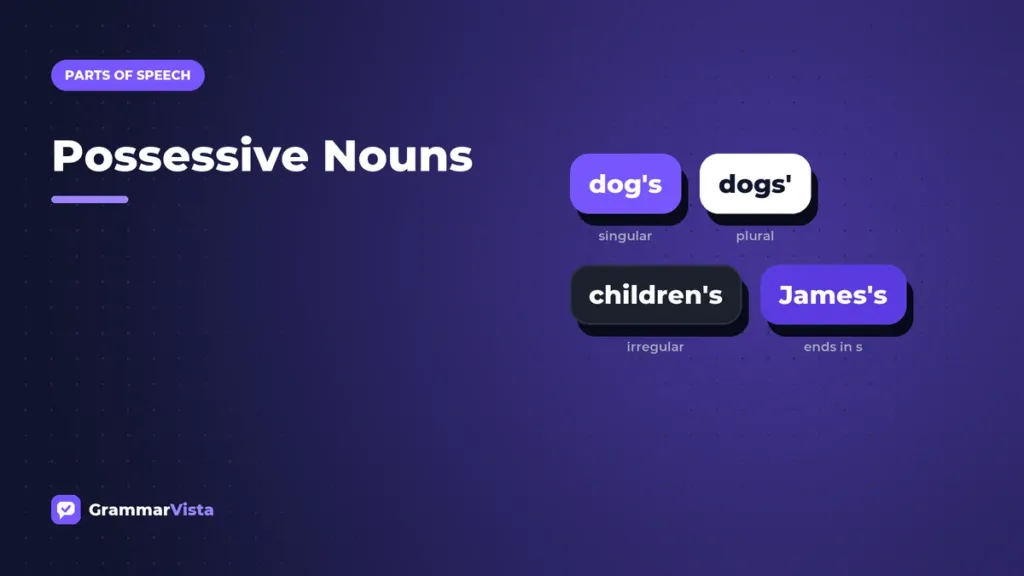
A possessive noun shows ownership or a close relationship, and it is usually formed with an apostrophe plus s: the manager’s office, the children’s toys. For plural nouns that already end in s, add only an apostrophe: the students’ grades.
Those two patterns cover most sentences, but names ending in s, shared ownership, and compound nouns trip up even careful writers. This GrammarVista.com USA guide walks through each rule with original examples, a quick-reference table, and a short practice set.
Key Takeaways
- Add ‘s to singular nouns, even those ending in s, in most American styles: the boss’s desk.
- Add only an apostrophe to plural nouns ending in s: the nurses’ station.
- Add ‘s to plural nouns that do not end in s: the women’s team.
- Use one apostrophe for shared ownership and one per noun for separate ownership.
- Never use an apostrophe to make a plural or with possessive pronouns such as its and theirs.
The Three Core Rules for Possessive Nouns
Before you place the apostrophe, decide whether the owner is singular or plural. Then apply one of these rules:
- Singular noun: add ‘s. the dog’s leash, Maya’s laptop, the city’s budget.
- Plural noun ending in s: add an apostrophe after the s. the dogs’ leashes, the teachers’ lounge.
- Plural noun not ending in s: add ‘s. the men’s room, the people’s choice, the mice’s nest.
A simple check is to write the plural first, then add the possessive mark. If the plural is teachers, the plural possessive is teachers’. If the plural is children, it becomes children’s.
| Noun | Possessive Form | Example Sentence |
|---|---|---|
| student (singular) | student’s | The student’s essay won first place. |
| students (plural) | students’ | The students’ essays were graded overnight. |
| child (singular) | child’s | The child’s backpack was on the bus. |
| children (plural) | children’s | The children’s museum opens at ten. |
| class (singular) | class’s | The class’s field trip was canceled. |
| the Garcias (family) | the Garcias’ | We parked in the Garcias’ driveway. |
| mother-in-law | mother-in-law’s | My mother-in-law’s recipe is a secret. |
Singular Nouns and Names Ending in S
This is the one area where American style guides disagree. Most guides, including The Chicago Manual of Style, add ‘s to singular names ending in s: James’s car, Mr. Ross’s class, Texas’s coastline.
AP style, which many newspapers and public relations teams follow, adds only an apostrophe to singular proper names ending in s: James’ car, Texas’ coastline. For singular common nouns, AP still uses ‘s, as in the boss’s approval.
Either approach is acceptable if you follow your assigned style and stay consistent within the document. The examples in this GrammarVista.com USA guide use the Chicago form, so you will see James’s and Chris’s.
Plural Possessives and Family Names
Family names cause frequent errors on holiday cards and invitations. Make the name plural first, then add the apostrophe:
- Smith becomes the Smiths, so the Smiths’ house.
- Lopez becomes the Lopezes, so the Lopezes’ dog.
- Davis becomes the Davises, so the Davises’ party.
Writing the Smith’s house refers to one person named Smith. If you mean the whole family, the apostrophe belongs after the plural s.
Joint vs. Separate Possession
When two people share one thing, put the possessive only on the last noun: Ana and Leo’s apartment means they live in the same apartment. When each person owns a separate thing, make every noun possessive: Ana’s and Leo’s phones means two different phones.
Quick rule: One thing shared, one apostrophe at the end. Separate things, an apostrophe on each owner.
Compound Nouns and Group Names
With a compound noun, the possessive goes at the end of the whole phrase, not on the main word: my sister-in-law’s job, the attorney general’s office, someone else’s coat.
The plural possessive of a hyphenated compound can look awkward, as in my sisters-in-law’s jobs. It is correct, but many writers rephrase with of: the jobs of my sisters-in-law.
Time, Value, and Measurement Expressions
Possessive forms also appear in common expressions of time and value. Because the noun is singular or plural, the usual rules still apply:
- a day’s work, one hour’s delay (singular)
- two weeks’ notice, three years’ experience (plural)
- a dollar’s worth, ten dollars’ worth (value)
Possessive Nouns vs. Plurals and Possessive Pronouns
An apostrophe never makes a noun plural. Write Tacos for sale, not Taco’s for sale, and the 1990s, not the 1990’s. The Excelsior OWL guide to apostrophe errors includes apostrophe errors in its list of the most common writing errors.
Possessive pronouns also skip the apostrophe: its, hers, ours, yours, theirs, and whose. The most common slip is writing it’s, which means it is; see its vs. it’s for a full breakdown, and read what a pronoun is to see how these forms differ from nouns. More apostrophe rules are collected in the Punctuation section.
How to Check Possessives When You Proofread
Apostrophe errors are easy to miss on screen, so give them a separate pass during your final edit:
- Search your draft for every apostrophe and every word ending in s before a noun.
- For each one, ask who or what owns the next word, and whether that owner is one or many.
- Delete any apostrophe that only makes a word plural, including decades and abbreviations.
- Confirm that its, whose, and theirs have no apostrophe.
For a complete revision routine, see our guide on how to proofread your writing.
Practice: Write the Possessive Form
Rewrite each phrase using a possessive noun.
- the leash that belongs to the puppy
- the uniforms that belong to the players
- the shoes that belong to the women
- the car that Chris owns (Chicago style)
- the cabin that Jen and Omar share
- the house where the Harris family lives
Answer key:
- the puppy’s leash
- the players’ uniforms
- the women’s shoes
- Chris’s car
- Jen and Omar’s cabin
- the Harrises’ house
The Bottom Line
Possessive nouns follow a short set of rules: decide whether the noun is singular or plural, then add ‘s or an apostrophe alone. Watch names ending in s, family names, and shared ownership, and keep apostrophes out of plurals and possessive pronouns. Continue with the Parts of Speech guides on GrammarVista.com USA.
Frequently Asked Questions
Can things that are not alive take a possessive noun?
Yes, inanimate nouns can take a possessive form, as in the car’s engine, the company’s policy, or the river’s edge. All are standard in American English. Some writers prefer an of phrase for objects, such as the leg of the table, so choose the version that sounds more natural.
What is a double possessive?
A double possessive combines of with a possessive form, as in a friend of Maria’s or a colleague of mine. It is standard English and often clearer than the alternative. A picture of Maria shows Maria, while a picture of Maria’s is a picture she owns, so the double possessive can prevent confusion.
How do you make an abbreviation possessive?
Treat an abbreviation like any other noun. Add ‘s for the singular, as in NASA’s budget or the CEO’s memo. For a plural abbreviation, form the plural first without an apostrophe, then add one: three CEOs becomes the CEOs’ salaries. Never use an apostrophe just to pluralize.
Should a possessive come before a gerund?
In formal writing, yes, a noun or pronoun before a gerund traditionally takes the possessive form: We appreciated Tom’s helping with the move or I don’t mind your calling late. In casual speech, many people say Tom helping, which most readers accept, but formal and academic writing usually keeps the possessive.