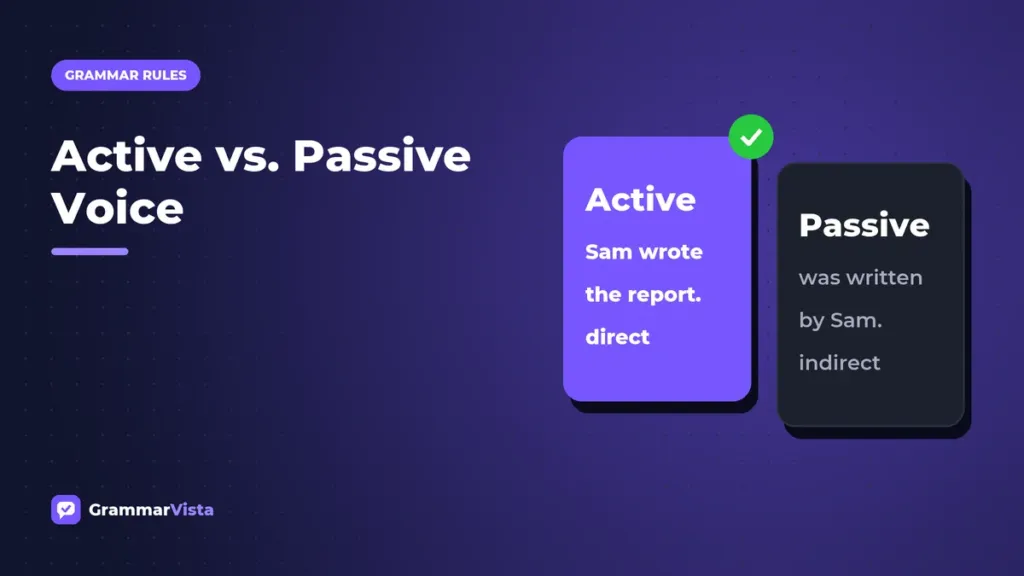
In the active voice, the subject performs the action: “The chef tasted the soup.” In the passive voice, the subject receives the action, and the verb uses a form of “be” plus a past participle: “The soup was tasted by the chef.” Active voice is usually clearer and shorter, but passive voice is correct and useful when the doer is unknown or less important.
This GrammarVista.com USA guide explains how to spot each voice, when to use it, and how to switch between them, with a practice set at the end.
Key Takeaways
- Active voice follows the pattern subject + verb + object: “Maya wrote the report.”
- Passive voice uses a form of “be” + a past participle, with an optional “by” phrase: “The report was written by Maya.”
- Passive voice is not a grammar error; it is a choice about emphasis.
- Use passive voice when the doer is unknown, obvious, or less important than the result.
- Only transitive verbs, which take a direct object, can be made passive.
How to Identify Active and Passive Voice
Look for two markers: a form of “be” (am, is, are, was, were, be, being, or been) followed by a past participle such as “written,” “taken,” or “approved.” If both are present and the subject receives the action, the sentence is passive.
Quick rule: Add “by zombies” after the verb. If the sentence still makes sense, as in “The window was broken by zombies,” it is passive.
Do not confuse passive voice with past tense. “The team finished the project” is past tense and active, while “The project was finished” is passive. Voice depends on who does the action, not when it happened.
Also, not every form of “be” signals passive voice. “The coffee was hot” pairs “was” with an adjective, not a past participle, so it is simply a linking-verb sentence.
Active vs. Passive Voice Examples
Each row shows the same idea in both voices. Notice how the verb changes in every tense.
| Active | Passive | Note |
|---|---|---|
| The committee approved the budget. | The budget was approved by the committee. | Same meaning; the active version is shorter. |
| Our dog chewed the remote. | The remote was chewed. | The “by” phrase is optional in passive voice. |
| Someone stole my bike last night. | My bike was stolen last night. | Passive works well when the doer is unknown. |
| The nurse will check your blood pressure. | Your blood pressure will be checked by the nurse. | Future tense uses “will be” + past participle. |
| Engineers are testing the new bridge. | The new bridge is being tested by engineers. | Progressive tenses use “being” + past participle. |
| The city has repaved Main Street. | Main Street has been repaved. | Perfect tenses use “been” + past participle. |
How to Change Passive Voice to Active Voice
- Find the doer of the action. It may appear in a “by” phrase, or it may be missing.
- Move the doer into the subject position. If no doer is named, supply a logical one, such as “someone,” “the team,” or “we.”
- Change the verb to its active form in the same tense.
- Place the original subject after the verb as the direct object.
For example, “The tickets were sold by volunteers” becomes “Volunteers sold the tickets.” Make sure the verb agrees with its new subject; our guide to subject-verb agreement covers the tricky cases.
When to Use Active Voice
Choose active voice for most writing, especially instructions, emails, and arguments. It shows who is responsible and usually needs fewer words. Federal plain language guidelines recommend the active voice to encourage understanding and cut excess words.
Active voice also sharpens academic claims. “Researchers have overstated the risk” is more direct than “The risk has been overstated.” See how this works in our guide on how to write a thesis statement.
When Passive Voice Is the Better Choice
- The doer is unknown: “The house was built in 1902.”
- The doer is obvious: “The suspect was arrested on Tuesday.”
- The receiver matters more: “Three hikers were rescued from the canyon.”
- You need a neutral tone: “An error was found in the invoice.” Use this carefully, and never to dodge responsibility.
- You are describing a method: “The samples were heated for ten minutes.” Lab reports often use passive voice this way, although APA style encourages active voice where possible.
Common Passive Voice Mistakes
Writers who mix up the two voices tend to repeat a handful of errors. This GrammarVista.com USA list pairs each one with a fix.
- Dangling modifier: “After reviewing the data, a decision was made.” Fix: “After reviewing the data, the board made a decision.”
- Stacked passives: “It was decided that the report would be revised.” Fix: “The editors decided to revise the report.”
- Intransitive verbs: “The package was arrived.” Fix: “The package arrived.”
- Wrong participle: “The cake was ate.” Fix: “The cake was eaten.”
Practice: Active or Passive?
Test yourself with this GrammarVista.com USA practice set. Label each sentence active or passive. Then rewrite the passive sentences in active voice.
- The volunteers planted forty trees along the river.
- The email was sent before the meeting.
- The final chapter was written by two authors.
- Our neighbors are painting their porch.
- The results will be announced by the principal on Friday.
- The storm knocked out power across the county.
Answer Key
- Active.
- Passive. Possible rewrite: “I sent the email before the meeting.” The original names no doer, so you supply a logical one.
- Passive. Rewrite: “Two authors wrote the final chapter.”
- Active. “Are painting” is a progressive verb, not a passive one.
- Passive. Rewrite: “The principal will announce the results on Friday.”
- Active.
The Bottom Line
Active voice puts the doer first and usually makes sentences clearer, so make it your default. Use passive voice on purpose when the doer is unknown, obvious, or less important than the result.
Find related lessons in our Grammar Rules section, apply them in essays and emails with our Writing Help guides, or explore more lessons on GrammarVista.com.
Frequently Asked Questions
Is passive voice grammatically wrong?
No, passive voice is grammatically correct. It is a choice about emphasis, not an error. Writing teachers discourage overusing it because it can hide who did an action and add extra words, but it is the right choice when the doer is unknown, obvious, or less important than the action itself.
How can I quickly tell if a sentence is passive?
Look for a form of “be” followed by a past participle, such as “was written” or “is being reviewed.” Then ask whether the subject performs the action or receives it. If the subject receives it, the sentence is passive. A “by” phrase naming the doer often appears, but it is optional.
Does past tense mean a sentence is passive?
No, tense and voice are separate. “The chef cooked dinner” is past tense and active, while “Dinner is cooked every night” is present tense and passive. Voice depends on whether the subject does or receives the action, and every tense can appear in either active or passive form.
Should I avoid passive voice in academic writing?
You should not avoid it entirely, but use it sparingly. APA style encourages active voice where possible, while many lab reports use passive voice to describe methods. Choose active voice for claims and arguments, and use passive voice when the focus belongs on the process or result rather than the researcher.